Having previously complained about a lack of "compare and contrast" coverage of Vista versus prior Microsoft operating systems, I feel I should weigh in with a little C&C of my own (with the caveat that this is a blog, not a white paper, so you won't be getting footnotes and fancy formatting—those cost extra).
We know that Vista will be attacked by hackers of all stripes. Only time will tell how well Vista resists attack. One thing to look for in the months to come is the emergence of any "class of vulnerabilities." These are not fragile students, but problems of similar type, for example, memory leaks or buffer overflows. You don't need to get too technical to spot this. Just watch for a Vista hack to be revealed and then patched, only to be followed by news of another hack via a minor variation on the previous technique. This would strongly suggest that code review has not been rigorous enough. and could well presage the sort of rolling patch situation we are in with XP and Office products. Painful as that patch situation is, the early emergence of evidence that Vista is going to be in the same boat will further discourage adoption.
And herein lies one of the variables that emerge from a C&C: rate of adoption. When Windows NT was first released it attracted very little attention from hackers (defined as people who like to pick things apart, for a range of reasons). They were heavy into UNIX back then because if you wanted to explore big and interesting networks, UNIX was the OS you would most likely encounter (if you wanted to do more than explore, the money was also in UNIX and/or mainframes). This created a false aura of security around NT. While UNIX hacks were being announced all the time, NT was relatively--albeit temporarily--unscathed.
But two things happened to change that. One was considered a success for Microsoft, growing adoption of NT in corporate America, as well as the government, the military, and colleges. The other was considered a success for the PC world: the widespread availability of cheap CD-ROM drives and CD-burners. No longer did you need a foot high stack of floppies to install or steal NT. Just a thin, slim, light and easy to conceal CD. Around the 1996-98 time frame you could buy a pirated NT CD for a couple of bucks in Hong Kong or get someone to burn you copy. I remember the first DefCon at which hackers started getting excited about NT. Part of that excitement came from the simple fact that NT was accessible. You could get at it in order to play with it.
So, two factors to consider for Vista are: ease of piracy and extent of adoption. Today we have much faster pipes down which to stuff pirated code and DVD-burners are standard equipment. The strength of Vista's copy protection will be a factor (one that is already under concerted attack). As to adoption. The very thing that Wall Street analysts are mumbling with foreboding--slower than hoped for Vista upgrading--could work to Microsoft's advantage. Several classes of hacking activity are all about the installed base (c.f. first Word macro virus of 1995 after Word doc format had become de facto standard).
But we must also contrast as well as compare, and the landscape of computer abuse today is much different from what it was a few years ago, most notably it is better-funded and more criminally-inclined. That will serve to negate the copy protection obstacles. Suppose you're a criminal who expects most banking systems to be Vista-based by oh-eight. Spending some serious money on cracking Vista in oh-seven might strike you as a good investment (and like they say, anyone who thinks organized crime doesn't make investments hasn't been to Vegas).
However, the most helpful history lesson at this juncture may well be that of "risk displacement" (also discussed here). Even if Vista holds up well in the face of concerted attacks and provides greater protection to users against some forms of information abuse, the level of effort expended to abuse information is unlikely to go down. Not to be flippant, but it is likely to go around. Improved technical controls typically lead to more concerted social engineering attacks (you put a password on the system, the attacker gets the user to reveal the password, and so on).
Just so we are clear, this is NOT the fault of Microsoft. This is the fault of human beings in general--flawed creatures that we are--and the failure of countries around the world to elicit better standards of behavior from their citizens. What would be wrong of Microsoft would be to foster the notion that Vista will somehow make the world a safer place for computing. With three "most secure yet" operating systems under its belt, and IT security spending at all time highs, Microsoft has to know that things are still not very safe out there.
.
Tuesday, January 02, 2007
Sunday, December 31, 2006
Told You So: Spam surge drives net crime spree
Not it's not my imagination: Spam is on the rise and criminals are to blame. Brings new irony to the phrase "there ought to be a law against it" and deeper for Bill Gates promise that spam will be solved in 2006.
p.s. Wonder why it's spam and not SPAM but sometimes Spam? Get the official word here.
p.s. Wonder why it's spam and not SPAM but sometimes Spam? Get the official word here.
Wednesday, December 27, 2006
Whole New Security Vista? There's a target painted on new Microsoft OS
"Hi-tech criminals are looking forward to the consumer release of Windows Vista, say security experts." BBC News. Why? Because it is presents new opportunities, new possibilities for abuse.
"What?" you say, "surely this is the 'most secure version of Windows yet.'" (As proclaimed by Microsoft.) According to the BBC article, if new features won't get you to upgrade to Vista, security enhancements should, according to the co-president of Microsoft's platform, products and services division, Jim Allchin,. Vista will still be worth getting, thanks to its better defenses against phishing attacks, spyware and other malicious code, Allchin told the BBC. "Safety and security is the overriding feature that most people will want to have Windows Vista for."
Unfortunately, lack of historical perspective is widespread in the marketing sector of the IT industry, and too often it spreads to the media that covers IT. Where are the articles that compare and contrast the claims for Vista with those made for Windows NT, which was also claimed to be the most secure version of Windows yet, as was XP Professional? (Notice a pattern here?)
Believe it or not, I have some sympathy for Microsoft at this point because it is faced with a three-pronged dilemma (and we all know those three-prongers can be painful). Here are the three in play at the moment:
At the turn of the year it is always interesting to consider what the future holds. Will Vista be a boon or a boondoggle? Developments on the security will likely be the deciding factor.
"What?" you say, "surely this is the 'most secure version of Windows yet.'" (As proclaimed by Microsoft.) According to the BBC article, if new features won't get you to upgrade to Vista, security enhancements should, according to the co-president of Microsoft's platform, products and services division, Jim Allchin,. Vista will still be worth getting, thanks to its better defenses against phishing attacks, spyware and other malicious code, Allchin told the BBC. "Safety and security is the overriding feature that most people will want to have Windows Vista for."
Unfortunately, lack of historical perspective is widespread in the marketing sector of the IT industry, and too often it spreads to the media that covers IT. Where are the articles that compare and contrast the claims for Vista with those made for Windows NT, which was also claimed to be the most secure version of Windows yet, as was XP Professional? (Notice a pattern here?)
Believe it or not, I have some sympathy for Microsoft at this point because it is faced with a three-pronged dilemma (and we all know those three-prongers can be painful). Here are the three in play at the moment:
- Claiming that something is the "most secure ever" is like painting a target on it. I recall arguing against the launch of a web security certification program back in about 1996 for this very reason. Hackers were big into defacing web pages at the time and locking down a site was pretty difficult with the tools available. So putting a "Certified Secure" sticker on the home page would have been a red rag to a herd of hackers.
- But Microsoft had to claim Vista wasthe most secure ever because there don't seem to be enough other new things in the OS to warrant paying the asking price for the upgrade.
- But Microsoft is a huge company and [IMHO] it is hard for huge companies to achieve excellence in anything, particularly where there are competing goals.
At the turn of the year it is always interesting to consider what the future holds. Will Vista be a boon or a boondoggle? Developments on the security will likely be the deciding factor.
Thursday, December 21, 2006
California Hacking on Such a Winter's Day: USC hacker sentence after UCLA hack
I thought the juxtaposition of these two stories was interesting, on the 12th and 21st of December:
UCLA warns 800,000 people that hacker gained access to their personal information
USC hacker sentenced to 6 months of home detention
Now add this November nugget to the mix:
Rising cost of data security breaches: $182 per record
Now consider this: the June 2005 breach of USC's online student application system compromised 275,000 records and caused the university to shut down the site for 10 days and the perp gets 6 months home detention. But if the cops had found one twentieth of an ounce of crack on the guy he would be going to jail for a minimum of five years. Somehow, something is screwed up here.
.
UCLA warns 800,000 people that hacker gained access to their personal information
USC hacker sentenced to 6 months of home detention
Now add this November nugget to the mix:
Rising cost of data security breaches: $182 per record
Now consider this: the June 2005 breach of USC's online student application system compromised 275,000 records and caused the university to shut down the site for 10 days and the perp gets 6 months home detention. But if the cops had found one twentieth of an ounce of crack on the guy he would be going to jail for a minimum of five years. Somehow, something is screwed up here.
.
Saturday, December 16, 2006
Internet Explorer 7 User Interface Fiasco: Am I nuts or not?
As astute readers will have surmised, I'm in my mid-fifties. At this time in a person's life it's not unusual to wonder, from time to time: Am I going soft in the head? For me, one of those times was my first use of IE7. Here is a little bit of what the program looked like when I installed it. Astute observers will observe there is no menu bar (File-Edit-View -etc.).
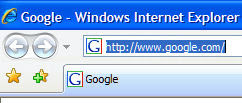 Because web browsing is now the thing I do the most on my computer--actually writing within the web browser as I am right now--I like to place my browser controls in a particular configuration. And I like some sort of consistency. So I set to work on IE7. I found you can get the old menu bar to show up, but the process is a pain. Furthermore, any further configuration hits the wall pretty quick. For example, the IE7 toolbars won't move, for me. This was so unexpected that I thought for sure my senile dementia was setting in. There I was, clicking and dragging and nothing was happening. In fact, the default UI is such a big departure from a. the norm, b. common sense, I deduced that, because I couldn't 'fix' it, I must be losing my marbles.
But no! It is Redmond that has lost its marbles on this one. How do I know? Another blog came to my rescue. I found this "Blog of Fusion" and began reading. Phew! It wasn't just me. Others were having the same "issues."
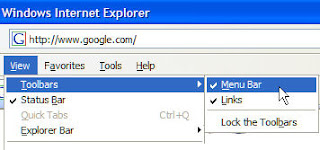
What had me really scared--before I found that blog--was an illustration in an article at microsoft.com. See that "Classic Menu" option? I couldn't find that in my copy of IE7, as shown below. Then I noticed the article was published in June. I had installed the 'shipping' version of IE7 in December. Tthis seems to be evidence that Microsoft--at one point in the Beta--allowed what the shipping version does not allow.
Check out the screen shots. My version of IE7 doesn't allow me to drag toolbars like the article shows. Seems they must have ditched this stuff during the final build and, with breezy indifference, failed to correct their own web site. BTW, that page at microsoft.com is the top result if you Google: internet explorer 7 toolbar customize.
 So, can you imagine how many thousands of people around the planet are going to a. try to customize the IE7 toolbar, b. get stuck, c. Google to that page, d. waste hours resolving the resulting contradictions?
I mean no offense to the poor microserf who wrote that stuff--he probably asked them to take it down and they didn't. When I was a Microsoft Vendor, everyone that I met in Redmond seemed smart, pleasant, and very earnest, but also out of touch with reality. And the entities to which they reported within the organization were more than a little messed up. In short, a classic example of how a bunch of smart, well-intentioned people can add up to a dumb bunch of decisions. (We are seeing another of these dumb decisions play out right now: "Improved security is the rasion d'etre for the next expensive Windows upgrade.)
One specific criticism of IE7 that I haven't seen elsewhere is that the row for the tabs of the new tabbed browsing feature (a feature that got me using Firefox as my main browser several years ago) seem to be fixed on the same line as the main buttons. This gives decidedly less space to the tabs than you have in Firefox. Also, if you remove the traditional menu, the View command is gone. There is no button for it. So the only way to get the traditional View menu item back is a right click in a select area of the tab/button bar.
Makes no sense to me, and thanks to fellow bloggers, I'm pretty sure I'm not senile, yet.
.
 Because web browsing is now the thing I do the most on my computer--actually writing within the web browser as I am right now--I like to place my browser controls in a particular configuration. And I like some sort of consistency. So I set to work on IE7. I found you can get the old menu bar to show up, but the process is a pain. Furthermore, any further configuration hits the wall pretty quick. For example, the IE7 toolbars won't move, for me. This was so unexpected that I thought for sure my senile dementia was setting in. There I was, clicking and dragging and nothing was happening. In fact, the default UI is such a big departure from a. the norm, b. common sense, I deduced that, because I couldn't 'fix' it, I must be losing my marbles.
But no! It is Redmond that has lost its marbles on this one. How do I know? Another blog came to my rescue. I found this "Blog of Fusion" and began reading. Phew! It wasn't just me. Others were having the same "issues."
What had me really scared--before I found that blog--was an illustration in an article at microsoft.com. See that "Classic Menu" option? I couldn't find that in my copy of IE7, as shown below. Then I noticed the article was published in June. I had installed the 'shipping' version of IE7 in December. Tthis seems to be evidence that Microsoft--at one point in the Beta--allowed what the shipping version does not allow.

Check out the screen shots. My version of IE7 doesn't allow me to drag toolbars like the article shows. Seems they must have ditched this stuff during the final build and, with breezy indifference, failed to correct their own web site. BTW, that page at microsoft.com is the top result if you Google: internet explorer 7 toolbar customize.
 So, can you imagine how many thousands of people around the planet are going to a. try to customize the IE7 toolbar, b. get stuck, c. Google to that page, d. waste hours resolving the resulting contradictions?
I mean no offense to the poor microserf who wrote that stuff--he probably asked them to take it down and they didn't. When I was a Microsoft Vendor, everyone that I met in Redmond seemed smart, pleasant, and very earnest, but also out of touch with reality. And the entities to which they reported within the organization were more than a little messed up. In short, a classic example of how a bunch of smart, well-intentioned people can add up to a dumb bunch of decisions. (We are seeing another of these dumb decisions play out right now: "Improved security is the rasion d'etre for the next expensive Windows upgrade.)
One specific criticism of IE7 that I haven't seen elsewhere is that the row for the tabs of the new tabbed browsing feature (a feature that got me using Firefox as my main browser several years ago) seem to be fixed on the same line as the main buttons. This gives decidedly less space to the tabs than you have in Firefox. Also, if you remove the traditional menu, the View command is gone. There is no button for it. So the only way to get the traditional View menu item back is a right click in a select area of the tab/button bar.
Makes no sense to me, and thanks to fellow bloggers, I'm pretty sure I'm not senile, yet.
.
Wednesday, December 13, 2006
Need Help With Computer Security? Check cobb.com
Just a quick reminder that you can find a bunch of free articles about computer security at the cobb.com web site. Enjoy!
Note This Blog: Dare Not Walk Alone is now with THINKFilm
 The civil rights film that I have been involved with for the past few years, Dare Not Walk Alone, is making progress!
A major update on the film and related projects, like the campaign to rebuild the house at 521 North Woodlawn that was featured in the film, has just been posted on the Dare Not Walk Alone blog. Check it out!
Monday, December 11, 2006
Blogs of Note: I guess scobb's non-blog made it
 Apparently there is something called "Blogs of Note" and this blog was listed there today. Not sure how much of an achievement that is, but thanks to anyone who might be responsible. I write mainly for my own sanity, but it's encouraging to think some people are reading what I write. To that end may I shamelessly plug some of the other blogs I have been building. They are not all in full flow yet, but getting there.
Obviously, the idea is to group my posts around subject matter. Hopefully it is not too ambitious. Time will tell. I think scobb's non-blog will continue to be the place that I put my thoughts on security.
More Secure Windows May Not Help: BusinessWeek makes a very good point
There's a nice article in Business Week that meshes with my view of computer security. Let me spell this out.
This may sound like a tall order--and it is--the task is not insurmountable. Law and order can eventually replace lawlessness, e.g. the Wild West. Standards of behavior within any given geographic entity can be improved, e.g. reduced drinking and driving in UK/US/et al.
Of course, these are changes that take decades to bring about. All the more reason to commit to the process now, rather than later. Remember, technology cannot create security; the sooner people set aside dreams of security based on the false promise that it can, the sooner the root problem will be addressed, and the better the interim security strategy will be.
- Microsoft is spending a lot of money right now to encourage people who use Windows to upgrade, for a fee, to a new version called Vista.
- To justify the fee for the new version Microsoft is talking a lot about how much more secure Vista is than previous versions of Windows.
- All this talk may be creating an expectation that computer users will encounter fewer security problems in the future.
- This expectation is probably false.
This may sound like a tall order--and it is--the task is not insurmountable. Law and order can eventually replace lawlessness, e.g. the Wild West. Standards of behavior within any given geographic entity can be improved, e.g. reduced drinking and driving in UK/US/et al.
Of course, these are changes that take decades to bring about. All the more reason to commit to the process now, rather than later. Remember, technology cannot create security; the sooner people set aside dreams of security based on the false promise that it can, the sooner the root problem will be addressed, and the better the interim security strategy will be.
Wednesday, November 29, 2006
What Are Security Breaches: Trousers they are not
Are you new to the world of computer security? If so you might appreciate a little orientation lesson.
Failure to prevent the breach may cost the bank money. The bank might be sued by the account holder. The bank may have to divert staff from normal duties to a review of records to determine the extent of the breach. If the breach exposes confidential information about a lot of customers the bank might lose some existing customers who are angry about this, and the marketing dollars that the bank spends to attract new customers might not work for a while due to bad publicity.
In my previous posting I cited a study that put a dollar amount "per record" on the cost of security breaches. I think the number is higher than many businesses realize.
- Computer security is about protecting information that is processed by computers, otherwise known as data, and the processes that use such data. This includes, for example, information about your bank account and how much money you have in it [data] and your ability to withdraw that money [process]. You want the data to be both secret and correct; and you want the process to work on demand. These are the three main pillars of computer security: confidentiality [secret]; integrity [correct]; availability [on demand].
- Computer security can also be referred to as information system security although technically an information system might include other elements besides just computers.
- Information system security is a part, or subset, of information security [because information security includes stuff that is not on computer, like a set of design drawings or company secrets whispered from one person to another].
- Information security can also be referred to as information assurance.
Failure to prevent the breach may cost the bank money. The bank might be sued by the account holder. The bank may have to divert staff from normal duties to a review of records to determine the extent of the breach. If the breach exposes confidential information about a lot of customers the bank might lose some existing customers who are angry about this, and the marketing dollars that the bank spends to attract new customers might not work for a while due to bad publicity.
In my previous posting I cited a study that put a dollar amount "per record" on the cost of security breaches. I think the number is higher than many businesses realize.
Wednesday, November 15, 2006
Rising Cost of Data Breaches: $182 per lost customer record
My hat is off to Larry for his study of security costs. In some ways this latest Ponemon Insitute study is probably more indicative of the state of things than the annual CSI/FBI survey.
If you are trying to get your company to do a better job of securing data, try multiplying the number of customer records your company processes/stores (CRP) times cost of loss per record (CLR) and you might have a good starting point for budgeting project to overhaul your current security (CRP x CLR = the hit to profits from any single incident in which CRP number of records are exposed).
Larry figures the figure for CLR is $182. A breach exposing 10,000 records is thus a $1.82 million problem. Spend that amount on security upgrades and you arguably save an unknown number of exposures (there is nothing that says you won't get hit twice in one year for example). Spend anything less than that and you are playing a high stakes game of chance with your business and, if you are a C-level exec or board member, with your personal and professional liability.
And don't let your managers fob you off with "these studies are just scare tactics." Tell them I know Larry Ponemon and Larry Ponemon is no scaremonger.
If you are trying to get your company to do a better job of securing data, try multiplying the number of customer records your company processes/stores (CRP) times cost of loss per record (CLR) and you might have a good starting point for budgeting project to overhaul your current security (CRP x CLR = the hit to profits from any single incident in which CRP number of records are exposed).
Larry figures the figure for CLR is $182. A breach exposing 10,000 records is thus a $1.82 million problem. Spend that amount on security upgrades and you arguably save an unknown number of exposures (there is nothing that says you won't get hit twice in one year for example). Spend anything less than that and you are playing a high stakes game of chance with your business and, if you are a C-level exec or board member, with your personal and professional liability.
And don't let your managers fob you off with "these studies are just scare tactics." Tell them I know Larry Ponemon and Larry Ponemon is no scaremonger.
Friday, November 10, 2006
Trust in Electronic Voting Eroding Faster Than Florida's Beaches
Yes folks, once again Florida leads the nation in eroding public trust in electronic voting systems. Check out the story so far in Sarasota. Lots of familiar themes and players. Zero doubt in my mind that the books were cooked (based on 30 years of experience with fraud, audit, and computer security).
In keeping with what I have blogged elsewhere, I predict the public will never trust electronic voting as much as paper and pencil ballots. And rightly so. I've worked with computers in all manner of situatons, from auditing oil companies with mainframes to building mission critical networks and securing mobile devices. They work quite well for a lot of things but not everything. I just don't see how you can make a trustworthy voting system out of them. So why bother? What is there to be gained?
In keeping with what I have blogged elsewhere, I predict the public will never trust electronic voting as much as paper and pencil ballots. And rightly so. I've worked with computers in all manner of situatons, from auditing oil companies with mainframes to building mission critical networks and securing mobile devices. They work quite well for a lot of things but not everything. I just don't see how you can make a trustworthy voting system out of them. So why bother? What is there to be gained?
Monday, November 06, 2006
Save Millions on IT: Delay Vista Upgrade
Come on IT people, this is a no-brainer. Don't upgrade to Vista, yet if ever. At least wait until Service Pack 1 has been released and tested (which I predict will be late 2007, early 2008). Here's five ways you save:
About the only redeeming qualities Microsoft can rightfully claim right now is the relative stability of XP and the massive philanthropy of its founder.
Stephen
- Fewer install hassles--let others learn the hard way and smooth it out for you.
- Lower software costs--avoid premiums [and headaches] on new versions.
- Reduced learning curve--if your users get Vista on their home PCs in the first half of 2007 they'll be training themselves.
- Reduced learning costs--as Vista training becomes commoditized.
- Hardware savings--the Vista delay (>2 years) has created a huge hardware surplus.
- Cut analyst bills--don't pay a dime to anyone who told you Vista was on track and early adoption was a good thing.
- shipped far too late but much too soon,
- more trouble than it's worth,
- often followed by successive versions which actually deliver on the original promises.
About the only redeeming qualities Microsoft can rightfully claim right now is the relative stability of XP and the massive philanthropy of its founder.
Stephen
Thursday, September 14, 2006
Wired on Top of Splogs
Correct me if I'm wrong, but Wired seems to be leading the discussion of splogs, those sick abuses of blogging that merely serve to line some sad maladjusted scammer's pockets.
Spam + Blogs = Trouble by Charles C. Mann
How to Fight Those Surging Splogs by Nicole Lee
Proof of another scobb rule: People Will Mess Up Every New Technology for Profit. Of course, there will be counter-attacks as legitimate interests fight back. But don't you just wish humans as a whole were less greedy and just generally better behaved?
Spam + Blogs = Trouble by Charles C. Mann
How to Fight Those Surging Splogs by Nicole Lee
Proof of another scobb rule: People Will Mess Up Every New Technology for Profit. Of course, there will be counter-attacks as legitimate interests fight back. But don't you just wish humans as a whole were less greedy and just generally better behaved?
Thursday, September 07, 2006
Risk displacement and hardware viruses
Check out this timely column from Adrian Kingsley-Hughes:
As Windows becomes harder to crack, could virus writers start to target hardware? "On August 25th, security firm Symantec engineers announced they had discovered a virus that leveraged a flaw in the AMD64 CPU. This virus, called W32/W64.Bounds, was capable of binding itself to Windows executables in such a way that made it hard to detect. However, it's now been shown that this virus doesn't have anything to do with in AMD CPUs, but instead with the X86-64 instruction set itself. But could this be a sign of things to come?"
Anyone who has heard me talk about risk displacement will know my answer to his question: Yes.
As you harden security in one area, softer areas will be targeted. Savvy security managers at large companies learned this in the nineties. As they began to install firewalls most attackers moved on to target other, less protected networks. In fact, this phenomenon is at the heart of the Turntide anti-spam technology that I helped develop. We bet that spam software would not waste bandwidth trying to stuff spam into networks that appear incapable of accepting spam at a high rate of messages per second. We were right.
And as Adrian points out in his column, widely deployed hardware is an attractive target for malware authors. The first Microsoft Word virus did not show up until Word was the most widely used word processing application. Email viruses did not appear until email was widely used. So the big variable in the emergence of a hardware virus threat is the extent to which a "hard to crack" version of Windows is deployed.
BTW, Adrian's web site is a gold mine of useful information about PC hardware and software, check it out at http://www.pcdoctor-guide.com/wordpress/.
As Windows becomes harder to crack, could virus writers start to target hardware? "On August 25th, security firm Symantec engineers announced they had discovered a virus that leveraged a flaw in the AMD64 CPU. This virus, called W32/W64.Bounds, was capable of binding itself to Windows executables in such a way that made it hard to detect. However, it's now been shown that this virus doesn't have anything to do with in AMD CPUs, but instead with the X86-64 instruction set itself. But could this be a sign of things to come?"
Anyone who has heard me talk about risk displacement will know my answer to his question: Yes.
As you harden security in one area, softer areas will be targeted. Savvy security managers at large companies learned this in the nineties. As they began to install firewalls most attackers moved on to target other, less protected networks. In fact, this phenomenon is at the heart of the Turntide anti-spam technology that I helped develop. We bet that spam software would not waste bandwidth trying to stuff spam into networks that appear incapable of accepting spam at a high rate of messages per second. We were right.
And as Adrian points out in his column, widely deployed hardware is an attractive target for malware authors. The first Microsoft Word virus did not show up until Word was the most widely used word processing application. Email viruses did not appear until email was widely used. So the big variable in the emergence of a hardware virus threat is the extent to which a "hard to crack" version of Windows is deployed.
BTW, Adrian's web site is a gold mine of useful information about PC hardware and software, check it out at http://www.pcdoctor-guide.com/wordpress/.


Wednesday, August 30, 2006
No, I won't live and breathe your product!
Why do software makers think you want to live and breathe their product? More and more applications seem to think they are the only reason you bought your computer. Even drivers are getting this way. I have recently installed HP printer drivers that are more than 50 megabytes. They add photoviewing, image management, file transfer, camera interfacing stuff that I don't want. They take over file associations. I bought the printer to print. Period. Am I the only person who just wants an HP printer to print? Or have I missed some liefstyle trend where printers are all about how I see the world and relate to it, digitally speaking?
Apaprently I am not the only person who has gotten ticked off...check out Simon Wilson's rant about the 170 megabyte HP driver. That was a while ago...it would be interesting to know if HP as reacted. It would sure be nice to have the option to go "basic driver only" during the install.
Apaprently I am not the only person who has gotten ticked off...check out Simon Wilson's rant about the 170 megabyte HP driver. That was a while ago...it would be interesting to know if HP as reacted. It would sure be nice to have the option to go "basic driver only" during the install.
Sunday, July 16, 2006
New Microsoft Same as the Old Microsoft?
So Microsoft has spent years perfecting a means of patching holes in its flagship product--the Windows XP operating system--holes that had left XP-based computer systems vulnerable to various types of attack. When your computer is attacked you worry about a number of things, probably three. You don't want strangers accessing your private data (confidentiality). You don't want to your documents messed up (integrity). And you don't want to be denied access to your documents or your system (availability).
Well it seems some recent XP patches are themselves attacking data integrity. I noticed this myself when I came downstairs one recent morning and found my laptop had rebooted itself. The cause of the reboot? The Windows Automatic Update. The effect? A bunch of typing and research was 'lost.' That's right, Windows had rebooted without saving the latest version of my documents (and Microsoft Word did not even offer to recover the work when I re-started it).
I couldn't quite believe this, until I found other people had noticed the same thing. Blogger Tim Rains has a nice piece on this problem and what to do about it.
Well it seems some recent XP patches are themselves attacking data integrity. I noticed this myself when I came downstairs one recent morning and found my laptop had rebooted itself. The cause of the reboot? The Windows Automatic Update. The effect? A bunch of typing and research was 'lost.' That's right, Windows had rebooted without saving the latest version of my documents (and Microsoft Word did not even offer to recover the work when I re-started it).
I couldn't quite believe this, until I found other people had noticed the same thing. Blogger Tim Rains has a nice piece on this problem and what to do about it.
Thursday, July 06, 2006
Getting the Hang of This
So, maybe the point of a blog is to publish stuff that others will not. Like stuff that I have written but some editor somewhere decided was not worthy of publication. Here is an example. Hopefully there will time for more.
Stephen
Stephen
Thursday, March 30, 2006
Laptop Thefts, Spam, and More of Same
Sigh...Some computer security vulnerabilities are timeless:
"Fidelity Investments last week disclosed that someone made off with a laptop containing the names, Social Security numbers and other information for 196,000 current and former Hewlett-Packard employees." Sci-Tech Today
The reasons for stealing laptops may change, but laptops used by business people are, by definition, loaded with business information. Now it seems, owing to corporate stupidity, they are also loaded with large amounts of personal information abouts large numbers of persons. The fact that a company like Fidelity had the 401K details of almost 200,000 people sitting on a laptop (instead of on a server in a locked room) is disturbing but sadly not surprising. It is not the first time something like this has happened and we confidently predict it won't be the last. Here's an article on the subject from 2000, ironically published in the HP Chronicle
As for newer vulnerabilities, there is a pretty good blog put out by Sunbelt, a Florida software company. Has some interesting stories about IE, eBay accounts for sale, and bots that might be used for more than spam (which has not gone away the way that Mr. Gates predicted--although this should come as no surprise, given that every major product in the history of Microsoft has been late).
Stephen
"Fidelity Investments last week disclosed that someone made off with a laptop containing the names, Social Security numbers and other information for 196,000 current and former Hewlett-Packard employees." Sci-Tech Today
The reasons for stealing laptops may change, but laptops used by business people are, by definition, loaded with business information. Now it seems, owing to corporate stupidity, they are also loaded with large amounts of personal information abouts large numbers of persons. The fact that a company like Fidelity had the 401K details of almost 200,000 people sitting on a laptop (instead of on a server in a locked room) is disturbing but sadly not surprising. It is not the first time something like this has happened and we confidently predict it won't be the last. Here's an article on the subject from 2000, ironically published in the HP Chronicle
As for newer vulnerabilities, there is a pretty good blog put out by Sunbelt, a Florida software company. Has some interesting stories about IE, eBay accounts for sale, and bots that might be used for more than spam (which has not gone away the way that Mr. Gates predicted--although this should come as no surprise, given that every major product in the history of Microsoft has been late).
Stephen
Thursday, January 26, 2006
Just in Time: Doom & Gloom for Oh Six
Wow, amazing how fast three months can pass. Here we are, late in January of 'oh six,' and I haven't even issued my annual proclamation about the state of the Internet and e-commerce. However, given my last posting, and my annual predictions in prior years, it probably comes as no surprise that I am not optimistic. Indeed, I can't remember the last time I was optimistic about the outlook for the Internet, maybe it was in the mid-to-late nineties, when I seem to recall a brief lull in virus outbreaks, very little spam or spyware, no phishing and no "for-profit" worms.
Alas, things have gone downhill since then. Sure, I use the Internet for a lot of things and find it incredibly useful. But I do so with trepidation, fully armed with paranoia and a variety of defensive mechanisms. My feeling today is that the incredible usefulness of the Internet is still, for a significant slice of the population, outweighed by the risks. My predictions for 2006? More large-scale privacy breaches, more articles about how some folks are turning away from the Internet, and yet more involvement by organized crime in acts of phishing, worming, and Internet fraud.
Oh, and the usual hand-wringing by countless boards and other bodies set up to "do something about this." Remember folks, we are less than four days away from solving spam, as predicted by Mr. Gates.*
Happy New Year!
Stephen
*Note, for all the things he has done wrong, like break the Sherman Antitrust law, and his failures, like not making Ctrl-Tab work the same in all Microsoft Office applications, I still have to confess immense admiration for Mr. Gates's approach to philanthropy. If only more CEOs, such as those in the drug industry and the petroleum industry, would give of their wealth the way that he has, kids today might not find it so hard to be unselfish.
Alas, things have gone downhill since then. Sure, I use the Internet for a lot of things and find it incredibly useful. But I do so with trepidation, fully armed with paranoia and a variety of defensive mechanisms. My feeling today is that the incredible usefulness of the Internet is still, for a significant slice of the population, outweighed by the risks. My predictions for 2006? More large-scale privacy breaches, more articles about how some folks are turning away from the Internet, and yet more involvement by organized crime in acts of phishing, worming, and Internet fraud.
Oh, and the usual hand-wringing by countless boards and other bodies set up to "do something about this." Remember folks, we are less than four days away from solving spam, as predicted by Mr. Gates.*
Happy New Year!
Stephen
*Note, for all the things he has done wrong, like break the Sherman Antitrust law, and his failures, like not making Ctrl-Tab work the same in all Microsoft Office applications, I still have to confess immense admiration for Mr. Gates's approach to philanthropy. If only more CEOs, such as those in the drug industry and the petroleum industry, would give of their wealth the way that he has, kids today might not find it so hard to be unselfish.
Sunday, October 30, 2005
Web Threats Do Keep Users Away
According to Matt Hines, reporting a study by Consumer Reports WebWatch in eWeek on October 26, "U.S. Internet users are cutting back on the hours they spend online, shunning e-commerce and refusing to give out personal information as a result of the rising tide of Web-based crimes related to identity theft...As a result of those concerns, at least 30 percent of the 1,500 people interviewed for the survey said they have reduced the amount of time they access the Internet." See Web Threats Keep Users Away
And we are not surprised. We have predicted this for several years, and will go on predicting it until there is a major improvement in standards of conduct on the Internet. Of course, that is unlikely to happen unless there is an improvement in standards of conduct in society in general, which is unlikely to happen while so many public figures continue to act in such a shameless way (think Martha Stewart, Richard Scrushy, Bernie Ebbers, the Rigas, Dennis Kozlowski and Mark Swartz, sixteen Enron executives and counting). It's not just the crimes these people have committed, it's the way so many of them have tried to shrug off their misdeeds, or deflect punishment by professions of faith, or cheerfully gone on with their lives, with no apology to the millions of people whose lives they damaged.
Anyone who thinks this behaviour has no effect on the moral standards of today's children, who are the Internet miscreants of tomorrow, probably hasn't tried raising kids recently.
Stephen
And we are not surprised. We have predicted this for several years, and will go on predicting it until there is a major improvement in standards of conduct on the Internet. Of course, that is unlikely to happen unless there is an improvement in standards of conduct in society in general, which is unlikely to happen while so many public figures continue to act in such a shameless way (think Martha Stewart, Richard Scrushy, Bernie Ebbers, the Rigas, Dennis Kozlowski and Mark Swartz, sixteen Enron executives and counting). It's not just the crimes these people have committed, it's the way so many of them have tried to shrug off their misdeeds, or deflect punishment by professions of faith, or cheerfully gone on with their lives, with no apology to the millions of people whose lives they damaged.
Anyone who thinks this behaviour has no effect on the moral standards of today's children, who are the Internet miscreants of tomorrow, probably hasn't tried raising kids recently.
Stephen
Monday, October 24, 2005
An "Activist Judge" Gets Security Right
I don't know if U.S. District Judge Royce Lamberth fits the current definition of "activist judge" but he recently acted in what I consider to be an admirable way by pro-actively preventing computer security problems. On October 20 he ordered the U.S. Interior Department "to disconnect from the Internet all computer equipment holding data related to trust accounts it manages for American Indians, a decision that could cripple large sections of the agency's computer network."
While this is only the latest in a long saga of actions and responses between Judge Lamberth and the Interior Department, it is a timely reminder of what life would be like if networks were not allowed to be connected to the Internet unless they could prove, to the satisfaction of independent experts, that there were secure. In the latest security review "investigators testified they would give the department's computer security an 'F' grade or "one notch lower than an 'F' ... a 'G.'"
But that is not the most alarming fact in this story. The failing grade came after the department had spent $100 million on security improvements.
And for those who think government agencies are, by their nature, wasteful and incompetent, I am willing to bet there are Fortune 500 companies out there that would fail the same test.
Stephen
While this is only the latest in a long saga of actions and responses between Judge Lamberth and the Interior Department, it is a timely reminder of what life would be like if networks were not allowed to be connected to the Internet unless they could prove, to the satisfaction of independent experts, that there were secure. In the latest security review "investigators testified they would give the department's computer security an 'F' grade or "one notch lower than an 'F' ... a 'G.'"
But that is not the most alarming fact in this story. The failing grade came after the department had spent $100 million on security improvements.
And for those who think government agencies are, by their nature, wasteful and incompetent, I am willing to bet there are Fortune 500 companies out there that would fail the same test.
Stephen
Friday, October 07, 2005
Dataflation Column Published
Okay, I took two months off (that's why I called it a non-blog).
Finally, Information Security Magazine published my column on dataflation (in the Perspectives column in the October 2005 issue). An expanded version is also available online here.
Hopefully it will spark some debate about how we cope with the steady unravelling of our secrets and the security they provide.
Stephen
Finally, Information Security Magazine published my column on dataflation (in the Perspectives column in the October 2005 issue). An expanded version is also available online here.
Hopefully it will spark some debate about how we cope with the steady unravelling of our secrets and the security they provide.
Stephen
Monday, August 01, 2005
Holey Internet, Michael Lynn and Cisco
LAS VEGAS -- 02:00 AM Aug. 01, 2005 PT -- Security researcher Mike Lynn roiled the Black Hat conference Wednesday when he resigned from his job at Internet Security Systems to deliver a talk about a serious vulnerability in Cisco IOS, the operating system powering its routers, defying efforts by the router manufacturer and his former employer to block the presentation. Wired
I have used dire words before and I stand by them. Check out our column from January, 2003.
Stephen
Sunday, July 31, 2005
U2, Amsterdam, Smart Cards, and Dataflation
I blame the long gap between posts on U2. A trip to see the band in concert, in Amsterdam, was my present to my wife on her birthday this year.
(Marital Bliss Tip #39: To experience "multiple gratitude" give your partner a trip for his or her birthday and get four stages of pleasure: one, the gift giving day; two, the days between the giving of the gift and the taking of the trip; three, the trip itself; four, the after-glow of telling other people about the trip when you get back).
We thought Amsterdam was a very cool city, even though they were experiencing something of a heat wave. Talk about a civilized, tolerant place! I'm not just talking about a sensible attitude to public transportation, herbal remedies, ethnic diversity, and sexual orientationz. You can take your dog most places, smoke tobacco if you feel like it, and get a good cup of coffee on just about every street. And you can use smartcards (read this if you are not sure what they are).
When you land at Amsterdam airport you can buy a smartcard with which you can then purchase train tickets to get into the city (a very easy and inexpensive way to make the journey). Then buy soft drinks at the station store, tram tickets to travel around the city, and so on. No need for bank notes and coins. When we got to the Amsterdam Arena for the concert we found that all the vendors there took Arena smartcards. Buy one and you can get beer or ice cream or whatever else in a flash. For example, the beer vendors (who stroll through the crowd wearing a keg in a backpack) can squirt you out a glass of beer while you pay by inserting card, hitting Ja, and removing card. No hassle with change means a much more efficient liquid refreshment delivery system.
So, the coolest smartcard has to be the specially minted U2 Vertigo Tour Smartcard that we bought that evening at The Arena. It will go into the commemorative picture frame, along with the tickets and the blurry cell-phone photos of the massive stage with the tiny stick figures of Bono and Edge blown up on the giant projection screen.
But what does this have to do with dataflation? Well, the trip did not prevent me from polishing off a column on the topic that should appear in an upcoming print issue of Information Security Magazine. There may also be an expanded online version where I go further into the practical and legal implications for ID theft victims.
And the widespread use of smartcards reminded me that deploying new data infrastructures is possible. Which means that, if someone comes up with a way to rein in dataflation that requires a new data infrastructure, opponents won't be able to use that requirement as an excuse not to implement it.
Stephen
(Marital Bliss Tip #39: To experience "multiple gratitude" give your partner a trip for his or her birthday and get four stages of pleasure: one, the gift giving day; two, the days between the giving of the gift and the taking of the trip; three, the trip itself; four, the after-glow of telling other people about the trip when you get back).
We thought Amsterdam was a very cool city, even though they were experiencing something of a heat wave. Talk about a civilized, tolerant place! I'm not just talking about a sensible attitude to public transportation, herbal remedies, ethnic diversity, and sexual orientationz. You can take your dog most places, smoke tobacco if you feel like it, and get a good cup of coffee on just about every street. And you can use smartcards (read this if you are not sure what they are).
When you land at Amsterdam airport you can buy a smartcard with which you can then purchase train tickets to get into the city (a very easy and inexpensive way to make the journey). Then buy soft drinks at the station store, tram tickets to travel around the city, and so on. No need for bank notes and coins. When we got to the Amsterdam Arena for the concert we found that all the vendors there took Arena smartcards. Buy one and you can get beer or ice cream or whatever else in a flash. For example, the beer vendors (who stroll through the crowd wearing a keg in a backpack) can squirt you out a glass of beer while you pay by inserting card, hitting Ja, and removing card. No hassle with change means a much more efficient liquid refreshment delivery system.
So, the coolest smartcard has to be the specially minted U2 Vertigo Tour Smartcard that we bought that evening at The Arena. It will go into the commemorative picture frame, along with the tickets and the blurry cell-phone photos of the massive stage with the tiny stick figures of Bono and Edge blown up on the giant projection screen.
But what does this have to do with dataflation? Well, the trip did not prevent me from polishing off a column on the topic that should appear in an upcoming print issue of Information Security Magazine. There may also be an expanded online version where I go further into the practical and legal implications for ID theft victims.
And the widespread use of smartcards reminded me that deploying new data infrastructures is possible. Which means that, if someone comes up with a way to rein in dataflation that requires a new data infrastructure, opponents won't be able to use that requirement as an excuse not to implement it.
Stephen
Sunday, July 03, 2005
Dataflation Defined
I came up with the term dataflation to describe an emerging phenomenon, one that could have some fairly serious implications for the future of many things (e-commerce and personal security to name a few). As the inventor of this term, I reserve the right to tweak the definition at some later date, but here is my first stab at it:
This is personal data that cannot easily be sucked back or reflated. To paraphrase the definition of inflation, we are talking about a persistent increase in the open availability of previously confidential consumer data or a persistent decline in the value of that data, caused by an inability to adequately control unauthorized access.
You cannot change your date of birth or your mother's maiden name. Your Security number is hard to change. Moving to a new address is a pain. Changing banks or switching jobs is not always practical. Yet these are the pieces of information out of which an identity thief can fashion your likeness so as to incur debts and acquire goods and services in your name.
And what if that happens? The personal cost can be enormous. Even if you can avoid paying fraudulent debts, the amount of time and stress it costs you can take a heavy personal toll. So who will pay that toll? The company that exposed your data? I don't think so. For a start, how are you going to prove that an identity thief got your data from Company A versus Company B? The first company that finds itself facing negligence claims pertaining to the exposure of your data will defend itself with the very fact of dataflation, i.e. tens of millions of records were compromised by dozens of companies in the first six months of 2005 alone.
Ironically, the aggregation of industry-wide gross negligence means that for John Doe to pin the blame on the donkeys that were supposed to be protecting his data is now an all but impossible task, unless he can get a signed confession from the identity thief himself that says, "Yes, I got Mr. Doe's data from a Citigroup computer tape that I stole from a UPS truck."
Do you see what I'm saying? There is a one in three chance your data is out there already. I'd say there is a 50/50 chance that basic personal data on half of all Americans will have been exposed by the end of the year. At that rate everyone's data is going to be compromised within a frighteningly short span of time.
There are plenty of studies that show the rampant insecurity of personal data is holding back the growth of e-commerce. One indication of dataflation is that growth in electronic trust and e-commerce cannot happen without more and more personal data. More user names, more passwords, more secret questions and answers, more unique identifiers. But at the current rate of data exposure, electronic trust will continue to decline as dataflation increases. That, along with all the fraudulent charge write-offs, could hurt the economy just as much as traditional monetary inflation .
Stephen
- Dataflation: the tendency of data to rapidly lose value due to factors such as large-scale unauthorized access, excessive abuse and loss of confidentiality.
This is personal data that cannot easily be sucked back or reflated. To paraphrase the definition of inflation, we are talking about a persistent increase in the open availability of previously confidential consumer data or a persistent decline in the value of that data, caused by an inability to adequately control unauthorized access.
You cannot change your date of birth or your mother's maiden name. Your Security number is hard to change. Moving to a new address is a pain. Changing banks or switching jobs is not always practical. Yet these are the pieces of information out of which an identity thief can fashion your likeness so as to incur debts and acquire goods and services in your name.
And what if that happens? The personal cost can be enormous. Even if you can avoid paying fraudulent debts, the amount of time and stress it costs you can take a heavy personal toll. So who will pay that toll? The company that exposed your data? I don't think so. For a start, how are you going to prove that an identity thief got your data from Company A versus Company B? The first company that finds itself facing negligence claims pertaining to the exposure of your data will defend itself with the very fact of dataflation, i.e. tens of millions of records were compromised by dozens of companies in the first six months of 2005 alone.
Ironically, the aggregation of industry-wide gross negligence means that for John Doe to pin the blame on the donkeys that were supposed to be protecting his data is now an all but impossible task, unless he can get a signed confession from the identity thief himself that says, "Yes, I got Mr. Doe's data from a Citigroup computer tape that I stole from a UPS truck."
Do you see what I'm saying? There is a one in three chance your data is out there already. I'd say there is a 50/50 chance that basic personal data on half of all Americans will have been exposed by the end of the year. At that rate everyone's data is going to be compromised within a frighteningly short span of time.
There are plenty of studies that show the rampant insecurity of personal data is holding back the growth of e-commerce. One indication of dataflation is that growth in electronic trust and e-commerce cannot happen without more and more personal data. More user names, more passwords, more secret questions and answers, more unique identifiers. But at the current rate of data exposure, electronic trust will continue to decline as dataflation increases. That, along with all the fraudulent charge write-offs, could hurt the economy just as much as traditional monetary inflation .
Stephen
Saturday, July 02, 2005
IBM v. MSFT, Good News At Last?
We interrupt a series of postings about the abysmal state of affairs in the world of information security to bring you this heartening bulletin: Convicted monopolist Microsoft must pay IBM almost $800 million "to resolve claims it bullied the big computer maker during the 1990s."
It is good to see justice meted out in a manner that Microsoft might understand, cash leaving its bank accounts. I am particularly pleased because Microsoft has never, to my knowledge, apologized to us poor sods who lost money in the fruitless struggle to make non-Microsoft applications run on a Microsoft OS that we later learned was intentionally rigged to foil us.
But consider the words: "resolve claims it bullied the big computer maker." This is how John Boudreau of the Mercury News described the news, and he is one of the better hi-tech journalists. Yet I'm tempted to take issue with the word "claims." After all, Microsoft was found guilty. Microsoft bullied other companies. That's a fact, not a claim.
It is good to see justice meted out in a manner that Microsoft might understand, cash leaving its bank accounts. I am particularly pleased because Microsoft has never, to my knowledge, apologized to us poor sods who lost money in the fruitless struggle to make non-Microsoft applications run on a Microsoft OS that we later learned was intentionally rigged to foil us.
But consider the words: "resolve claims it bullied the big computer maker." This is how John Boudreau of the Mercury News described the news, and he is one of the better hi-tech journalists. Yet I'm tempted to take issue with the word "claims." After all, Microsoft was found guilty. Microsoft bullied other companies. That's a fact, not a claim.
The Solid Insider Threat
I just got back from Nebraska and man are my arms tired (sorry, very old joke) but seriously, my brain did get tired. I took a very challenging creative writing course on the campus of the University of Nebraska at Lincoln. There will be more about the course, and the campus, in a later post...
Right now I'm going to have to talk about the latest round of data/ID theft/abuse. Seems like the year I decided to step back from the privacy/security/fraud beat that has been my life for the last 25 years, boom! The world has woken up to just how big a mess its data are in. Consider a couple of recent articles that awaited my return from the prairie.
First, a useful reminder from Paul Nowell of the AP, that insiders at data-rich companies are a major threat to privacy. This was very timely and Paul talked to some good people, including the man who should be this nation's IT-czar, Peter G. Neumann. Howell also talked to a vice president of marketing at San Francisco-based Vontu, a firm specializing in data loss prevention. Now, I don't know Vontu or the man in question, Steve Roop, but he got it right when he said "About 70 to 80 percent of the risk is from insiders, although not all of them are malicious..."
This had been the received wisdom about risks to information security for decades until, during the last five years or so, more and more people who were surveyed ranked outsiders, notably outside attackers using the Internet, as being more serious. Big mistake! There's no way--having read and understood the history of how humans abuse trust, technology, and information--you can believe the outsider is more of a threat to the security of your information than the insider. Sure, it might seem that way when you're trying to stop a bunch of zombies from DDoS'ing your web farm into submission, or you're trying to rid your network of some particular nasty virus. But the trusted employee who turns heel and walks across the street to the competition with an SD card full of your customer data in his shoe, that's still the biggest threat, partly because it is the toughest to mitigate.
And let's not forget 'the number of people surveyed' factor. If you ask 250 people who work in computer security to name the biggest threat to that security, what you get is an opinion, not a fact. Like I say, those folks may sure as heck feel more pain from outsiders. But them thinking it is so does not make it so. Furthermore, computer security is not information security, as the award-winning Chief Security Officer of Choicepoint has hopefully learned by now. I will make that point in my next post, tackling the IRS, Choicepoint and something I call data-flation.
Right now I'm going to have to talk about the latest round of data/ID theft/abuse. Seems like the year I decided to step back from the privacy/security/fraud beat that has been my life for the last 25 years, boom! The world has woken up to just how big a mess its data are in. Consider a couple of recent articles that awaited my return from the prairie.
First, a useful reminder from Paul Nowell of the AP, that insiders at data-rich companies are a major threat to privacy. This was very timely and Paul talked to some good people, including the man who should be this nation's IT-czar, Peter G. Neumann. Howell also talked to a vice president of marketing at San Francisco-based Vontu, a firm specializing in data loss prevention. Now, I don't know Vontu or the man in question, Steve Roop, but he got it right when he said "About 70 to 80 percent of the risk is from insiders, although not all of them are malicious..."
This had been the received wisdom about risks to information security for decades until, during the last five years or so, more and more people who were surveyed ranked outsiders, notably outside attackers using the Internet, as being more serious. Big mistake! There's no way--having read and understood the history of how humans abuse trust, technology, and information--you can believe the outsider is more of a threat to the security of your information than the insider. Sure, it might seem that way when you're trying to stop a bunch of zombies from DDoS'ing your web farm into submission, or you're trying to rid your network of some particular nasty virus. But the trusted employee who turns heel and walks across the street to the competition with an SD card full of your customer data in his shoe, that's still the biggest threat, partly because it is the toughest to mitigate.
And let's not forget 'the number of people surveyed' factor. If you ask 250 people who work in computer security to name the biggest threat to that security, what you get is an opinion, not a fact. Like I say, those folks may sure as heck feel more pain from outsiders. But them thinking it is so does not make it so. Furthermore, computer security is not information security, as the award-winning Chief Security Officer of Choicepoint has hopefully learned by now. I will make that point in my next post, tackling the IRS, Choicepoint and something I call data-flation.
Thursday, June 09, 2005
Not As Reassuring As They Might Think
So now we hear CitiFinancial is dropping backup tapes after data loss. Perhaps they're thinking that this announcement, together with the repeated statement that it was UPS that lost the tapes, will somehow show they care: "CitiFinancial plans to begin encrypting data and sending it to credit bureaus electronically after data tapes containing the personal information of 3.9 million customers were lost by UPS." This report actually does three things.
And don't miss the really scary part of Citi's statement: "We and other lenders provide this information each month to credit bureaus...via nationally recognized couriers and require them to use enhanced security procedures to transport the tapes from our data center to the bureaus."
So, like I said in my last posting, large numbers of unencrypted tapes full of your financial details have been flying around the country for years. Untold numbers have likely gone missing, after all, if this was an isolated incident, Citi would be the first to defend their practice of using UPS by saying "This is the first time this has ever happened." It is only the new notification laws that are finally shedding light on this sad state of affairs.
Stephen
- Confirms that the lost tapes were not encrypted.
- Confirms that Citi knows that the data really should have been encrypted in the first place.
- Suggests that sending the data electronically is somehow safer than using a courier.
And don't miss the really scary part of Citi's statement: "We and other lenders provide this information each month to credit bureaus...via nationally recognized couriers and require them to use enhanced security procedures to transport the tapes from our data center to the bureaus."
So, like I said in my last posting, large numbers of unencrypted tapes full of your financial details have been flying around the country for years. Untold numbers have likely gone missing, after all, if this was an isolated incident, Citi would be the first to defend their practice of using UPS by saying "This is the first time this has ever happened." It is only the new notification laws that are finally shedding light on this sad state of affairs.
Stephen
Tuesday, June 07, 2005
3 Things (The Cool and The Crap)
Middle Aged White Guys have a reputation for complaining about things and I'm no exception. Ask me to name 3 things that suck and I would have no problem naming 9:
Stephen
- Credit scores
- The Dish Network 921 DVR
- The AC system on 1996 Jeep Grand Cherokees
- The Windows OS
- Prescription drug prices
- Prescription drug advertisements
- Prescription drug profits
- Ratio of drug company research dollars to advertising dollars
- Banks
- Treo 600 and 650 (the photo in the upper right of this page was taken with a Tree 600)
- Apple iPod (the real ones--not the Shuffles--make CD players seem so limited)
- Firefox web browser (tabbed browsing's now the only way for me to work the web)
Stephen
Reasons to Believe
This week we 'welcome' a division of Citigroup to the ranks of major companies that have fessed up this year to 'losing' customer data (i.e. allowing copies of data about people--such as their names, addresses, phone numbers, Social Security numbers and other information that could be used to rip them off--to go missing).
This particular data, covering 3.9 million people, was on tapes being shipped via UPS. Citigroup said the tapes were lost by UPS Inc. "in transit to a credit bureau." So, three things to note:
The reality is that IT has delivered massive gains in productivity and profits over the last ten years. The nature of businesses and humans is that the true cost of achieving these gains lags behind the gain curve. It is time for corporate America to accept that data about customers requires way more protection than it has so far been afforded. Smart companies will maintain their edge by increasing security in smart ways. It doesn't have to cost the earth, but it does cost, therefore some will cut corners and lose customers (if I had a Citi account right now I'd be closing it).
Stephen
This particular data, covering 3.9 million people, was on tapes being shipped via UPS. Citigroup said the tapes were lost by UPS Inc. "in transit to a credit bureau." So, three things to note:
- Misplacing data is nothing new--it's been happening for years--but the public has rarely heard about it before now. The fact that they are hearing about it now is mainly due to California's groundbreaking SB1386 notification law.
- Misplacing data tapes should not be a problem. All data tapes that leave the secure environment of the data center should be encrypted by default. That so many big companies are apparently shipping unencrypted tapes via ordinary shipping services is a disgrace, and definitely a failure to meet a reasonable standard of due care.
- Until one of these companies gets sued big time, this needless exposure of consumers to the risk of identity theft will continue.
The reality is that IT has delivered massive gains in productivity and profits over the last ten years. The nature of businesses and humans is that the true cost of achieving these gains lags behind the gain curve. It is time for corporate America to accept that data about customers requires way more protection than it has so far been afforded. Smart companies will maintain their edge by increasing security in smart ways. It doesn't have to cost the earth, but it does cost, therefore some will cut corners and lose customers (if I had a Citi account right now I'd be closing it).
Stephen
Subscribe to:
Posts (Atom)